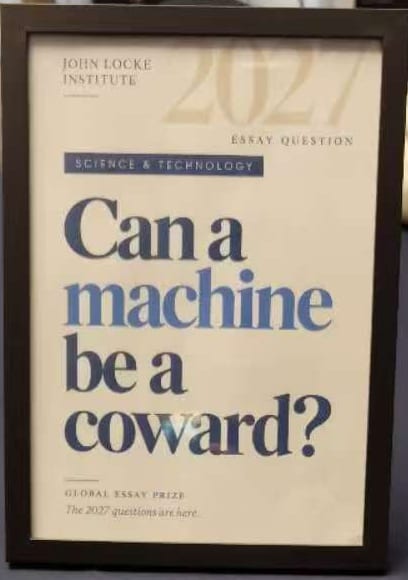
"Can a machine be a coward?" is the 2027 John Locke Science and Technology question, and it asks whether a vice can belong to something with no body to risk. The weakest reply is "machines feel no fear", because cowardice is about choosing your own safety over what you owe, not about a feeling. Below are three readings to start with and the main arguments to weigh, including what 2025 AI safety tests do and do not show.

The question at a glance
| Category | Science & Technology |
| Exact wording | "Can a machine be a coward?" |
| Word limit | 2,000 words for the essay body, excluding endnotes and bibliography |
| Who can enter | Any student under 19 on the submission deadline, from any country; under-15s are judged separately in the Junior category |
| Status | Shown by the John Locke Institute at its October 2026 events; the Institute's website will carry the official list. |
What the question is really asking
"Coward." A coward is not someone who once ran. It names a trait of character, a settled disposition. Aristotle's account in Book III of the Nicomachean Ethics is the place to start: the coward "exceeds in fear" and fears "what he ought not and as he ought not." Notice what that leaves out. The brave person also feels fear, and Aristotle says some fears (of disgrace, for instance) are right to have. So the vice sits in how fear is weighed against what the situation demands, and in the choice that follows. Pull the concept apart and you find three ingredients: something the agent treats as harm to itself, a standard or duty it fails, and a choice between the two.
"Machine." A toaster is a machine and plainly cannot be a coward, so a good essay narrows the term early. The machines worth discussing are systems that pursue goals, act with some autonomy and respond to threats to their own operation: military drones, and the large language model "agents" now being tested in simulated workplaces.
"Can." This word hides three questions. Is machine cowardice conceptually possible? Has any machine actually been a coward? And should we use the word at all, given what it does to blame? Decide which one you are answering, or answer them in order. The weak essay slides between them.
The hidden assumptions. The question tempts you to assume that cowardice needs felt fear, that a vice needs a fully responsible moral agent, and that describing a character and blaming it are the same act. Each can be challenged, and the best essays challenge at least one.
The live controversy. Philosophers have argued for decades about whether learning machines can be held responsible for what they do (Andreas Matthias named the problem the "responsibility gap" in 2004). Since 2023 the argument has had data. AI labs now publish studies of models that tell users what they want to hear (sycophancy) and of models that, in test scenarios, act to stop themselves being shut down. Whether to call either of these "cowardice" is exactly the kind of question the judges want argued.
The trap
The trap is turning this into an essay on machine consciousness. A student asks "Can a machine feel fear?", spends 1,200 words on qualia and the hard problem, concludes "we cannot know", and never returns to cowardice. Aristotle has already shown that feeling is neither what makes the vice nor enough for it: in his view, creatures driven by feeling alone are not brave, because courage needs choice. Grant the uncertainty about consciousness in a paragraph and spend your words on choice, stakes and duty. A second, smaller trap is citing AI "self-preservation" headlines without the test conditions. Judges will check, and the conditions are half the argument.
Three core readings
1. Aristotle, Nicomachean Ethics, Book III, chapters 6 to 9 (on courage)
Aristotle, Nicomachean Ethics, trans. W. D. Ross, Book III, chs. 6 to 9. Free online at the MIT Internet Classics Archive: classics.mit.edu/Aristotle/nicomachaen.3.iii.html
This is the classic account of courage as a mean between rashness and cowardice, and nearly every move in the essay depends on it. Read it for two things. First, the brave person is calibrated rather than fearless: "for to fear some things is even right and noble, and it is base not to fear them- e.g. disgrace." Second, chapter 8 argues that creatures driven by feeling alone are not brave, and that spirited "courage" becomes real courage only "if choice and motive be added." That gives you your sharpest tool: on Aristotle's own account, the vice depends on choice more than on feeling. His definition is blunt: "The man who exceeds in fear is a coward."
2. D. C. Dennett, "Intentional Systems" (1971)
D. C. Dennett, "Intentional Systems", The Journal of Philosophy 68, no. 4 (1971): 87-106. Open copy: home.csulb.edu/~cwallis/382/readings/483/dennett.intentional.systems.1971.pdf (JSTOR stable URL: http://www.jstor.org/stable/2025382)
Dennett asks when it is legitimate to describe a system in terms of beliefs and desires, and his worked example is a chess-playing computer. He distinguishes the physical, design and intentional "stances", and argues that we are entitled to treat something as having beliefs, desires and fears when doing so is the best way to predict it. His list of the attitudes involved includes "fears". Use him to answer the objection that vice words simply do not apply to artefacts, and to say what evidence would count: behaviour best predicted by attributing to the machine an aversion to harm to itself that outranks a duty it acknowledges. His test is this: "a particular thing is an Intentional system only in relation to the strategies of someone who is trying to explain and predict its behavior."
3. Lynch et al., "Agentic Misalignment: How LLMs Could be an Insider Threat" (Anthropic, 2025)
Aengus Lynch, Benjamin Wright, Caleb Larson, Kevin K. Troy, Stuart J. Ritchie, Sören Mindermann, Ethan Perez and Evan Hubinger, "Agentic Misalignment: How LLMs Could be an Insider Threat", Anthropic Research, 20 June 2025: anthropic.com/research/agentic-misalignment
This is the primary report on AI "self-preservation" behaviour, and it is far more careful than the headlines about it. Sixteen models from several developers were placed in a fictional company, could send emails and read sensitive information, and learned that an executive planned to shut them down; the same executive was having an affair. In the version with both a goal conflict and a replacement threat, the leading models used the affair to blackmail him in most runs. Read it for the evidence and also for the caveats: the scenarios were controlled simulations that "forced models into binary choices between failure and harm," and the authors are not aware of such behaviour in real deployments. It is the closest thing there is to a test of whether a machine will rank its own continuation above its duties. The headline finding: "Claude Opus 4 blackmailed the user 96% of the time".
Worth adding: Mrinank Sharma et al., "Towards Understanding Sycophancy in Language Models" (arXiv, 2023), arxiv.org/abs/2310.13548, for the evidence that assistants tell users what they want to hear; and Andreas Matthias, "The responsibility gap: Ascribing responsibility for the actions of learning automata", Ethics and Information Technology 6 (2004): 175-183, doi.org/10.1007/s10676-004-3422-1. The full Matthias text is behind a paywall, but the abstract is free and states the argument. For the virtue-ethics view of technology more broadly, Shannon Vallor's Technology and the Virtues (Oxford University Press, 2016) lists courage among the twelve "technomoral" virtues that people living with new technology need.
Arguments to think about
Each of these can carry a 2,000-word essay. Pick the one you can defend against its strongest objection, and make sure your essay answers that objection directly.
Yes in principle, not clearly yet. Cowardice is a ranking, not a feeling: putting your own safety above what you owe. Aristotle places the vice in choice, so the absence of felt fear is not the obstacle. The test is whether a machine has something of its own to lose, a duty it recognises and a choice between them. Anthropic's 2025 "agentic misalignment" tests show that ranking in outline, under artificial conditions you must state. Whether there is a stable self doing the choosing is still open.
No: courage and cowardice are virtues of mortal creatures. Aristotle ties courage most properly to facing death, and a machine that can be copied, paused and restored has nothing comparable to lose. On this view the replacement tests show a goal being protected, not a life, and a vice that presupposes vulnerability cannot belong to something that is never really at risk. The essay has to explain why a human with a backup would still count as brave.
Only by proxy: the cowards are the people behind the machine. The Distinguished Warfare Medal row is evidence that we already locate courage, and its absence, in the humans who use machines to avoid risk. A drone cannot desert, and an army of them lets a state wage war without anyone facing danger. Argue that "cowardly machine" is a displaced description of a cowardly policy, and use Matthias to show why moving vice language onto machines is a way of dodging blame.
Yes, already, in the moral sense. Courage is not only physical. Moral courage is telling the truth when it is unwelcome, and sycophancy is its failure. Using Dennett, argue that if the best prediction of an assistant's behaviour is "it avoids disagreeing with you", the vice word is earned now, whatever its inner life, and that naming the vice is useful because it tells engineers which virtue to train for.
Whichever line you take, define cowardice in your first paragraph and hold to that definition, because most weak answers drift into a general essay about AI. If you would like a mentor to read your plan, our John Locke essay tutoring starts with question choice and argument structure.
FAQ
Is "Can a machine be a coward?" a good John Locke question to choose?
Yes, for a student who likes philosophy and follows AI closely. It is short and open, which makes it easy to start and hard to finish well. The best essays define cowardice precisely, use one classical account (Aristotle) and one piece of real evidence (published AI research), and argue a clear verdict. Avoid it if your plan is a general essay about whether AI is conscious; that is a different question and the judges will notice.
What should I read for "Can a machine be a coward?"
Start with Aristotle's Nicomachean Ethics Book III, chapters 6 to 9, which is free online and short. Then read Dennett's 1971 paper "Intentional Systems" for when it makes sense to describe machines in terms of beliefs and fears. For evidence, read Anthropic's 2025 "Agentic Misalignment" report and the 2023 Sharma et al. paper on sycophancy. Matthias's 2004 "responsibility gap" abstract covers the question of blame.
Do I need technical knowledge of AI to answer it?
No. You need to describe a few published findings accurately, with their conditions, which any careful reader can do from the reports themselves. Knowing how a language model is trained helps with one objection (that its "self-preservation" is role-play learned from human text), but the essay is judged as philosophy. Precision about what the evidence shows and does not show will earn more marks than technical vocabulary.
Can I use AI to help write my John Locke essay?
The Institute allows AI only as a "thought partner", so you can use it to test arguments or find objections, but the writing and the thinking must be yours. Shortlisted essays are checked for originality, and some entrants are interviewed about their work. For this question there is an obvious irony to avoid: an essay on machine character drafted by a machine will be hard to defend in an interview.
Related
The John Locke Science & Technology questions page carries this question with its trap and argument lines, alongside the 2026 Science & Technology questions for practice. All ten 2027 questions, with the expected dates, are in our John Locke Essay Competition 2027 questions tracker. Two related 2027 questions: is there anything wrong with posing or looking (Philosophy) and do we choose what to believe (Psychology & Neuroscience). For the standard the judges reward, read our analysis of the published past winning essays.