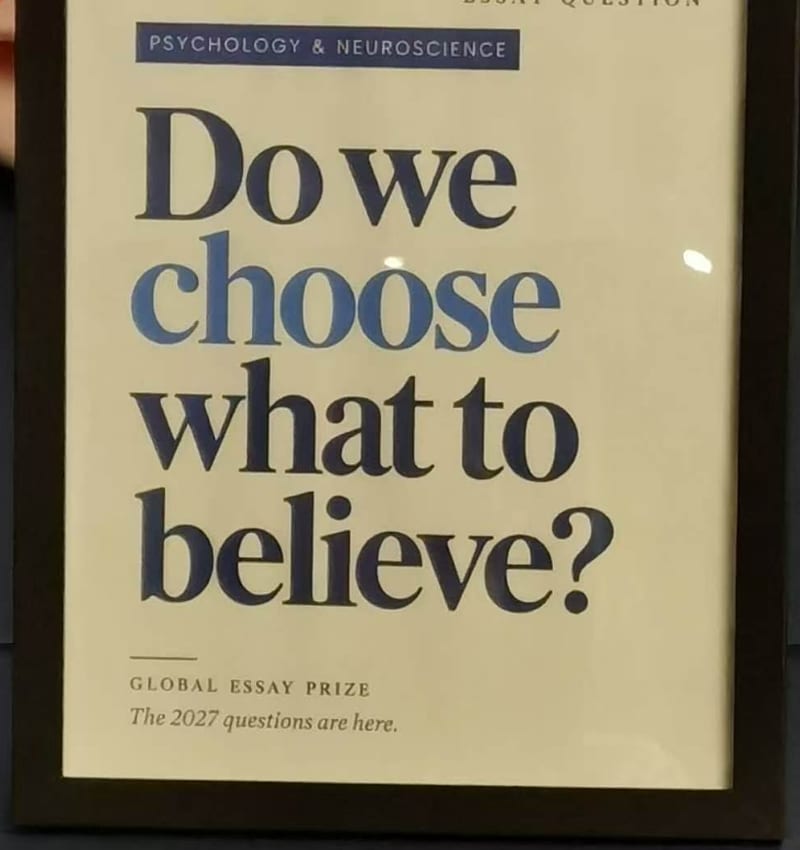
The 2027 John Locke Psychology & Neuroscience question, "Do we choose what to believe?", asks whether belief is something we decide, like an action, or something that happens to us, like a perception. Almost nobody defends believing at will any more, so the live question is whether the indirect control we do have (what we read, whom we trust, how hard we test a claim) deserves the word "choose". Below are three readings to start with and the main arguments to weigh.

The question at a glance
| Category | Psychology & Neuroscience |
| Exact wording | "Do we choose what to believe?" |
| Word limit | 2,000 words, not counting endnotes, bibliography, diagrams or tables of data (2026 rules) |
| Who can enter | Any student under 19 on the submission deadline, from any country; under-15s are judged separately in the Junior category |
| Status | Shown by the John Locke Institute at its October 2026 events; the Institute's website will carry the official list. |
What the question is really asking
Three words carry the question: "choose", "believe" and "we".
Believe. To believe something is to take it to be true. That is why belief is a strange candidate for choice. You can choose to imagine that it is raining, or to say it is, or to act as if it were. Believing it is a different matter, because believing is answerable to how things are, and your wishes have no say in how things are.
Choose. Philosophers usually ask whether belief is voluntary, and they separate several kinds of control. William Alston's taxonomy, the standard one, distinguishes the direct control you have over raising your arm, the control you have over switching on a light (one act, but the world has to cooperate), long-range control of the kind you have over getting fit, and mere indirect influence. Almost nobody now defends direct control over belief. Almost everybody accepts that we have indirect influence: we pick what we read, whom we trust and what we pay attention to. So the live question is whether any of the weaker kinds of control deserves the word "choose".
We. The question does not ask whether beliefs are caused by brains, or whether a belief can be voluntary in the abstract. It asks whether we choose. That raises the question of who the chooser is. Is it the conscious, reflective self? The whole person, including processes that run below awareness? Or "we" as a society, which arguably does settle what it will accept through courts, laboratories and schools?
The hidden assumption to expose is that "choose" and "cause" are opposites. A belief can be caused by evidence, by your brain and by your upbringing and still have passed through a step you controlled. The question is whether there is such a step, and where it sits.
What the 2023 prize essay did, and why 2027 is a different task
The Institute set a close relative of this question in 2023: "Are beliefs voluntary?" It published Hannah Kim's third-prize essay, titled "Psychological Involuntariness", and it is worth reading before you start.
Kim argues that belief is "an involuntary response to perception", so the whole case runs through perception. She brings three kinds of evidence. The first is neurobiology: delusional disorder, emotion-perception deficits after traumatic brain injury, the default mode network, and Soon and colleagues' 2008 finding that decisions could be predicted from brain activity "seven to ten seconds" before people were aware of them. The second is unconscious bias. The third is sociocultural, including an fMRI comparison of Chinese and Western students and the story of geocentrism as groupthink. It is an energetic, well-organised essay, and as our analysis of the published prize essays points out, it never gives the other side a paragraph.
Two further weaknesses are instructive. The central inference runs from "unconscious" to "involuntary", and that inference proves too much: if Soon's result shows that belief is not chosen, it shows that no action is chosen either, so it cannot tell belief apart from raising your hand. And the bibliography mixes journal articles with WebMD, Study.com and a LinkedIn post, which is exactly the "competent use of evidence" criterion the judges mark.
The 2027 wording closes off Kim's route. "Choose" is an ordinary verb, and an essay has to say what choosing is before it can deny that it happens. "We" makes it hard to treat your own brain as an outside force: if the default mode network is part of you, its work is in some sense yours. A 2027 essay that simply re-runs the 2023 argument will be answering the wrong question.
The trap
The trap is to answer with a list of brain regions. Students who find that belief formation is largely automatic conclude "so we do not choose", and stop. That ignores indirect control, which everyone in the literature accepts, and it equates "unconscious" with "not ours", which the word "we" invites you to question. The second trap is the survey: Descartes says this, Spinoza says that, the folk say something else. Pick a sense of "choose", defend it, and say what the evidence shows about that sense.
Three core readings
1. Bernard Williams, "Deciding to Believe", in Problems of the Self (Cambridge University Press, 1973), pp. 136-151. Cambridge Core chapter page. The key passage is quoted in full in an open-access 2023 article in Manuscrito.
This is the founding text. Williams sets out to discuss "how far, if at all, believing something can be related to decision and will", and his answer is that the impossibility of believing at will follows from what belief is. Belief aims at truth: "If I could acquire a belief at will, I could acquire it whether it was true or not." A state you knowingly produced without regard to truth could not count, for you, as a belief. Use it to state the strongest case against choice in a paragraph, then test it. The argument is about believing in full awareness that you chose, so ask what happens when the choosing is gradual or unnoticed.
2. Ziva Kunda, "The Case for Motivated Reasoning", Psychological Bulletin 108(3) (1990), pp. 480-498. DOI 10.1037/0033-2909.108.3.480; PubMed record.
The classic review of how wanting a conclusion changes reasoning. Kunda's case is that desire works through biased memory search and selective standards of evidence, and that it is limited: people reach the conclusions they want only when they can construct "seemingly reasonable justifications" for them. In her words, "people are not at liberty to believe anything they like". For this question the most useful part is a study she reports (Lord, Lepper and Preston, 1984). Telling people to be objective did not reduce their bias against research that contradicted them. Asking them to consider what they would have concluded had the study found the opposite removed it. That is the empirical case for saying the will reaches belief through method rather than resolve.
3. Erik Asp and colleagues, "A Neuropsychological Test of Belief and Doubt: Damage to Ventromedial Prefrontal Cortex Increases Credulity for Misleading Advertising", Frontiers in Neuroscience 6 (2012), article 100. Open access on PubMed Central.
The neuroscience paper to build on, and free to read. It tests Daniel Gilbert's 1991 "Spinozan" proposal that understanding a claim means first representing it as true, with rejection as a later, effortful step. Patients with damage to the ventromedial prefrontal cortex were more credulous about misleading adverts than brain-damaged and healthy comparison groups, even when the advert carried a correcting disclaimer. The authors conclude that "Belief is first, easy, inexorable with comprehension of any cognition", while disbelief is "retroactive, difficult, vulnerable to disruption". Use it to argue that if any part of belief formation looks like a choice, it is the doubting. Pair it with the pre-registered challenge by Vorms and colleagues (Cognition, 2022), who found that Gilbert's truth bias does not hold for implausible statements.
For the map of the philosophical debate, including Alston's four kinds of control and recent experimental work on how ordinary people use "choose", read Boespflug and Jackson's "Doxastic Voluntarism" in the Stanford Encyclopedia of Philosophy (2024).
Arguments to think about
Each of these can carry a 2,000-word essay. Pick the one you can defend against its strongest objection, and make sure your essay answers that objection directly.
We cannot choose a belief, but we can choose to doubt it. Nobody can believe a claim just by deciding to (Williams), and the evidence suggests the mind accepts what it understands and doubts only with effort (Gilbert's model, tested by Asp and colleagues). What we control is how hard we test a belief. Kunda's work suggests that deliberately considering the opposite corrects motivated reasoning where a simple resolution to be objective does not. On this view, responsibility for belief sits in that choice.
Yes, in the sense that matters. Take the ordinary meaning of "choose" seriously. Nottelmann and colleagues' finding that people call indirectly acquired beliefs "chosen" can be read as a description of how the concept works, not as confusion. On that reading, we choose our beliefs the way we choose our fitness: through sources, company and habits over months. The essay then argues that this long-range control is reliable enough to ground blame, which is exactly where it has to disagree with Alston.
No, and procedure will not rescue it. A harder line. The "choice" to consider the opposite is itself the product of temperament, training and prior beliefs that nobody chose, so pushing choice back one step only moves the problem. Williams shows that direct choice is incoherent; Gilbert and Asp show the default is acceptance. Conclude, with Alston, that we should stop thinking of belief in terms of duty and blame and talk instead about good and bad cognitive habits.
The "we" is a group. Individuals cannot choose beliefs, but communities do something close to it. A court chooses a standard of proof; a journal chooses what counts as evidence; a school chooses what is taught as settled. These are decisions about what a group will accept, and they shape what its members end up believing. An essay on this line would need a worked case and a clear account of how group acceptance becomes individual belief.
These lines differ mainly in what they take "choose" to mean, so settle the definition first and let it decide the structure. If you want feedback on that framing before drafting, our John Locke tutoring pairs each student with a mentor from question choice to submission.
FAQ
Is "Do we choose what to believe?" a good John Locke question to choose?
Yes, for a student who reads both philosophy and psychology. The question rewards someone who can define "choose" carefully and then bring experimental evidence to bear, which few entrants manage. It is a poor choice for a student who wants to write a pure neuroscience survey, because the 2023 prize essay on a near-identical question already shows the limits of that approach. Expect many entrants to argue "no"; a well-defended qualified answer will stand out.
What should I read for the John Locke 2027 question on belief?
Start with Williams's "Deciding to Believe" for the philosophical argument, Kunda's "The Case for Motivated Reasoning" for how desire shapes belief, and Asp and colleagues' 2012 lesion study for the neuroscience of doubt. Then read the Stanford Encyclopedia entry on doxastic voluntarism for the map of the debate, and Kaplan, Gimbel and Harris (2016) on why political beliefs resist counter-evidence. The Asp and Kaplan papers and the encyclopedia entry are free to read online.
Can I use the 2023 prize essay "Are beliefs voluntary?" as a model?
Read it, then do something different. Hannah Kim's essay is a good example of committing to a thesis and gathering evidence for it, and it placed third. It also shows what to avoid: no counter-argument, a jump from "unconscious" to "involuntary", and some non-academic sources. The Institute checks originality, so do not borrow its structure or examples. Use it to see what a judged essay at this level looks like.
Does this question need neuroscience, or can I answer it philosophically?
It sits in Psychology & Neuroscience, so the judges will expect empirical evidence carrying real weight, not decorating a philosophy essay. The strongest structure is to set out the conceptual problem in a paragraph or two (what would choosing a belief even be?), then let studies settle what can be settled, then return to what the evidence cannot decide. Describe each study's sample and limits; a 40-person scan is suggestive, not conclusive.
Related
The John Locke Psychology & Neuroscience questions page carries this question with its trap and argument lines, alongside the 2026 Psychology & Neuroscience questions for practice. All ten 2027 questions, with the expected dates, are in our John Locke Essay Competition 2027 questions tracker. Two related 2027 questions: do you know something they don't (Theology) and is there anything wrong with posing or looking (Philosophy). For the standard the judges reward, read our analysis of the published past winning essays.