Harvard International Review Academic Writing Contest · Years 7–13
Harvard International Review Writing Contest Preparation
An article of 800 to 1,200 words on world affairs, written in the style of a published magazine piece and scored out of 60 by the editors of the Harvard International Review. Finalists then defend it, live, to a panel. We prepare students for both halves.
A semester of live online classes with at most eight students, two or six private hours, and draft edits that continue until the article is ready to submit. Every mentor studied at an Ivy League, Oxbridge or G5 university.
From USD 1,000. Both packages and both prices are on this page.
HIR Academic Writing Contest · Atlantic Ivy students
earned Silver or Gold
Top 10%
of entrants worldwide is where Silver begins
1 in 5
entrants receive any medal at all
Medals sit on a global curve: Gold for roughly the top 3%, Silver the top 10%, Bronze the top 20%. In the Fall/Winter 2025 cycle the HIR listed 30 Gold, 60 Silver and 90 Bronze medallists. Our writing results, year by year
The contest
What is the HIR Academic Writing Contest, and why does it end with a defense?
The Harvard International Review is a magazine of world affairs edited by Harvard students, and its contest asks school students to write for it. The task is not a school essay. It is a short-form article of 800 to 1,200 words, in Associated Press style, on one of the year's themes, with every factual claim linked to its source. The editors score it out of 60 on twelve published criteria, and half of those marks are for style rather than ideas.
The contest runs three cycles a year, and students in grades 7 to 12 (Years 7 to 13) can enter any of them. Our course targets the Fall/Winter deadline of January 2, 2027. Since 2026 there has been a separate Junior Division for grades 7 and 8, judged apart from the seniors, which makes this the best first contest for younger writers.
What sets it apart is the finalist round. On Defense Day, a virtual oral round, each finalist gives a fifteen-minute presentation of their article and takes questions from a panel, rather like a viva. The HIR also uses it to check that the student wrote the piece, under a strict no-AI policy. Strong writers who cannot defend their work do not medal, which is why our curriculum ends with timed mock defenses.
- 1,200
- words, maximum
- AP
- style, with hyperlinked sources
- 60
- points on the published rubric
- 15 min
- Defense Day presentation

2026 themes
- 01Global Culture in the Digital Era
- 02Security in a Multipolar World
- 03Technology, Innovation, and Power
- JRInventions that Changed How We Live (Junior Division, grades 7–8)
Senior themes are analysed from a global perspective rather than a US one. Source: hir.harvard.edu/contest.
What a result means
The ladder, from entry to Gold
Medals are awarded on a global curve, so a Silver means the same thing in Dubai as it does in Boston. The cutoffs are the HIR's own; the one figure we can vouch for is ours.
- 01
Entry
An 800 to 1,200 word article in AP style on one of the year’s themes, scored out of 60 by HIR editors.
- 02
Commendation
Strong scores that fall short of a medal receive High Commendation, Commendation or a writing prize.
- 03
Bronze
Roughly the top 20% of entrants worldwide. Finalists present and defend their article on Defense Day.
- 04
Silver
Roughly the top 10% worldwide. Eight in ten of our students have reached this rung or the one above it.
- 05
Gold
Roughly the top 3% worldwide: in Fall/Winter 2025, 30 Gold medals across the whole field.
Our results
Eight in ten of our students earned Silver or Gold.
Silver begins at roughly the top 10% of entrants worldwide, and only about one entrant in five receives any medal. Each row below is the proportion, not a headcount: of every ten Atlantic Ivy students who entered, eight finished in the top tenth of the field.
We do not treat this as a guarantee and we would rather you did not either. What it shows is that the rubric rewards skills that can be taught in a semester, provided someone teaches them.
Atlantic Ivy students
The field worldwide
80%
of ours, Silver or Gold
10%
of the field, Silver or Gold
60
rubric points, taught one by one
How we work
Three things we do that most HIR prep does not.
The rubric is public, so our method is to take it literally. The people reading the drafts should have written at this level themselves. The drafts should keep coming until the article is right. And the topic has to be one the editors have not already read, which means it has to be the student's own.
01
Every mentor studied at an Ivy League, Oxbridge or G5 university.
We are not a tutor marketplace, and "a top university" is not good enough. The people who read your child's drafts went through Yale, Harvard, Cambridge and Oxford, and the course is led by mentors who live this material: Netra Easwaran was Vice President of the Yale International Relations Association, and Matt Mauriello coaches argumentation and Defense Day as a North American debating champion.
Groups are capped at eight, so the same mentor reads every article closely every week.
Meet the writing mentors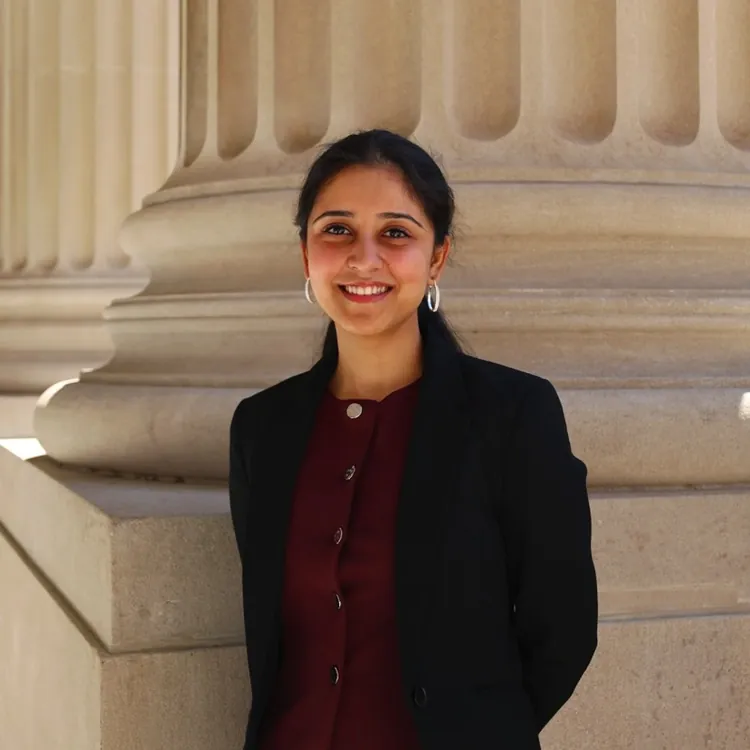
Netra Easwaran
Yale University
B.A. Political Science · Yale International Relations Association

Matt Mauriello
Harvard College
2023 North American Debating Champion

Peregrine Beckett
University of Cambridge
MSt candidate · Head Coach, Columbia Debate Society

Ricky Huang
University of Oxford
Director of Training, Oxford Union · Founder
One article, one autumn
- Draft 1The topic is on every front page. Which part of it has nobody covered?
- Draft 2Good angle. Now every claim needs a linked source, not a paraphrase.
- Draft 3This reads as an op-ed. Analyse the mechanism, do not take a side.
- Draft 4AP style pass: numerals, acronyms, attribution.
- Draft 5Ready to submit. Now rehearse the fifteen minutes.
02
Unlimited draft edits, on both packages.
Most programmes sell "two rounds of feedback". An article that has to survive twelve criteria and a panel is not finished in two rounds. Our students send a draft whenever they have one and get it back with line-by-line comments against the rubric, and this continues until the piece is ready to submit.
This applies to Package 1 as much as to Package 2. What you pay more for is private hours with a mentor, on topic selection and the defense, not access to feedback.
03
An angle nobody else has taken, found with the student, never handed to them.
The first criterion on the rubric is Topic, and full marks go to a subject that is "under-covered by mainstream media". It is where most entries fail quietly. Hundreds of students pick the same three stories from the same three front pages, and the editors can tell by the headline. We do not supply a topic. In the theme workshops the mentor takes the year's themes apart with the student, maps out the angles everyone else will write, and keeps asking what the student actually knows and cares about, until a story emerges that is theirs and that the editors have not read fifty times already.
Then the mentor plays the panel. The hardest question the article invites is put as hard as it can be put, weeks before Defense Day. If the argument survives that, it is worth writing.
Fall semester 2026
Choose your package
Both packages follow the same live curriculum from the week of September 7 through December. Late joiners are welcome through early October with catch-up materials. Most families choose Package 2.
Step 1 · Age group
Step 2 · Weekly class time
All three options cover the same curriculum; pick whichever fits your week.
Step 3 · Package
Package 1
USD 1,000
20 group hours + 2 private hours
The full semester curriculum, from AP style to a mock Defense Day, with two private hours on the article itself.
- 20 hours of live group instruction
- 2 hours of one-on-one tutoring
- Unlimited draft edits until submission
- Full curriculum through submission
- Defense Day preparation
Package 2
USD 1,300
20 group hours + 6 private hours
The same curriculum, plus six private hours: topic selection with a mentor, live draft work and individual Defense Day coaching.
- 20 hours of live group instruction
- 6 hours of one-on-one tutoring
- Unlimited draft edits until submission
- Personalised topic selection
- Individual Defense Day coaching
Returning Atlantic Ivy families save 20% on this course with code RETURNER27 at checkout. The HIR's own registration fee is separate and paid to the HIR directly.
How the editors score
The 60-point rubric
The HIR Submission Guide publishes the exact rubric: twelve criteria, each scored 1 to 5, split evenly between content and style. A brilliant argument in sloppy AP style loses as many marks as a polished piece with nothing to say. Our curriculum is built criterion by criterion.
Content
30 points- 01
Topic
5/5 = Under-covered by mainstream media, clearly tied to the theme
- 02
Introduction
5/5 = A hook that sets up the argument
- 03
Structure and transitions
5/5 = Concise topic sentences, a clear logical path
- 04
Use of evidence
5/5 = Relevant, compelling evidence for every claim
- 05
Analysis of evidence
5/5 = Creative analysis that goes beyond the obvious
- 06
Coherence of argument
5/5 = Reads like a sophisticated analyst, not a student
Style
30 points- 01
Tone
5/5 = Analysis, not op-ed; consistent with published HIR articles
- 02
Spelling, punctuation, grammar
5/5 = 0–2 errors in the whole piece
- 03
HIR style guide adherence
5/5 = AP style, acronyms, numbers, names handled correctly
- 04
Citations
5/5 = Every factual claim hyperlinked to its source
- 05
Source quality
5/5 = Varied, reliable sources at HIR standard
- 06
Ease of reading
5/5 = Reads at the level of a published HIR article
Paraphrased from the official HIR Submission Guide rubric (1 = D/F through 5 = A+). Finalists are selected on rubric score, then medals combine the written score with Defense Day performance.
HIR contest deadlines 2026–27
Three cycles a year, one we build the semester around.
Dates verified against hir.harvard.edu/contest. Registration and payment must be completed on the official form before submission; admissions are rolling and capacity is limited.
The Junior Division
Introduced in Spring 2026 for grades 7 and 8, with its own theme ("Inventions that Changed How We Live") and its own judging pool, so younger writers are never scored against seniors. Everything else matches the Senior Division: the same article length, the same 60-point rubric, the same Defense Day. Our Years 7–9 class prepares both divisions side by side.
| Cycle | Submission deadline | Defense Day | Status |
|---|---|---|---|
| Spring 2026 | May 31, 2026 | July 11, 2026 | closed |
| Summer 2026 | August 24, 2026 | October 5, 2026 | closed |
| Fall/Winter 2026 | January 2, 2027 | February 5, 2027 | our target |
Upcoming dates
HIR Writing Contest- Oct 25, 2026EDTRegister with HIROfficial page
- Jan 2, 2027ESTEssay due
- Feb 5, 2027ESTDefense Day
Week by week
From first principles to Defense Day
Ten weeks of structured instruction, one topic building on the next, ending with mock oral defenses in the official format.
Week 01
The HIR Contest & International Affairs Writing
How the contest works, what medallists have in common, and how journalistic international-affairs writing differs from school essays.
Week 02
AP Style & Journalistic Conventions
The Associated Press style the contest requires: attribution, hyperlink citations, concision, and voice.
Week 03
Research Methods & Source Credibility
Finding and evaluating sources on fast-moving international topics. Building a source file.
Week 04
Choosing Your Theme & Angle
Analysing the annual themes and finding an under-covered angle — the single biggest differentiator in scoring.
Week 05
Structuring a Short-Form Article
Making every paragraph earn its place in 800–1,200 words.
Week 06
Evidence & Analysis Paragraphs
Weaving fresh sources, actors, and mechanisms into every section.
Week 07
Drafting Workshop
Full first drafts with structured peer and instructor feedback.
Week 08
Revision & Editorial Polish
Editing to publication standard: clarity, accuracy, and style.
Week 09
Submission Preparation
Formatting, registration, and final checks for the January 2 deadline.
Week 10
Defense Day Preparation
Timed mock defenses in the official format: a 15-minute presentation of your article, then panel questions — exactly what finalists face.
Common questions
What parents ask before enrolling
Planning the article yourself? Print the free HIR article blueprint: a plan for the 1,200 words and a prep sheet for Defense Day.
What is the HIR Academic Writing Contest?
The Harvard International Review Academic Writing Contest is an international affairs writing competition run by the Harvard International Review, open to students in grades 7–12 (Years 7–13). Entrants write an 800–1,200 word article in AP style on one of the annual themes. Finalists present and defend their work at a virtual oral round called Defense Day.
How are medals awarded?
Gold medals go to roughly the global top 3% of entrants, Silver to the top 10%, and Bronze to the top 20%, based on written scores and Defense Day performance. Non-finalists with strong scores receive High Commendation, Commendation, and writing prizes. 80% of our students have earned Silver or Gold.
What is Defense Day and do you prepare students for it?
Defense Day is the oral round where finalists give a 15-minute presentation of their article and answer questions from a panel — similar to a viva. It is the part most entrants are least prepared for, so our curriculum ends with timed mock defenses, and Package 2 includes individual Defense Day coaching.
Is AI allowed in the contest?
No. The HIR strictly prohibits AI writing tools and uses multiple detection tools on every entry. Our course develops genuine research and writing skill, and we teach students how to document their process so their work stands up to scrutiny.
Which deadline does this course target?
The course runs from the week of September 7 through December and targets the Fall/Winter cycle deadline of January 2, 2027, with Defense Day on February 5, 2027. The contest also runs spring and summer cycles each year.
How much does the HIR contest cost to enter?
The Harvard International Review requires contestants to register and pay before they are eligible to submit, but it does not publish the fee on the public contest page — it is shown during registration on the official form (hawc-register.paperform.co). Admissions are rolling and capacity is limited, so register early in the cycle. The registration fee is separate from our course tuition and paid directly to the HIR.
How competitive is the HIR contest?
Medals are awarded on a global curve — Gold to the top 3%, Silver to the top 10%, Bronze to the top 20% — so roughly four in five entrants do not medal. In the Fall/Winter 2025 cycle the HIR listed 30 Gold, 60 Silver, and 90 Bronze medallists, which implies on the order of 900–1,000 scored entries in that cycle alone, with most medallists coming from China, Korea, Singapore, and the United States. Our students’ 80% Silver-or-above rate is measured against that field.
Is the HIR contest worth it for university applications?
It is one of the few writing competitions with a named Harvard affiliation, a published rubric, and an oral defense — so a Gold or Silver medal is a credible, verifiable signal of analytical writing ability. It is not a Harvard admissions programme and carries no admissions advantage by itself. Its value is the portfolio piece (a publishable 1,200-word article), the medal listing on the HIR site, and the research and presentation skills that transfer to the John Locke Essay Prize, the Concord Review, and eventually university coursework.
What is the Junior Division and what is its theme?
Introduced in Spring 2026, the Junior Division is for students in grades 7–8 (Years 8–9) and is judged separately from the Senior Division (grades 9–12). For 2026 the Junior theme is “Inventions that Changed How We Live”, while Senior entrants choose from three international affairs themes. Our Years 7–9 class covers both, since some Year 9 students fall in the Senior Division by US grade.
How is this different from your John Locke course?
Our John Locke track is hyper-focused on one competition essay. This course is geared toward general academic writing — research, structure, style, and oral defense — using the HIR contest as its goal. Many students take this course in the autumn and progress to John Locke preparation in January.
Free resources
HIR guides and what comes next
Everything we have published on the contest. No email form, no paywall.
01
The Complete HIR Contest Guide
Deadlines, medal cutoffs, the 60-point rubric, AP style and Defense Day drills, in one long read.
02
Free Article Blueprint
A printable plan for an 800 to 1,200 word HIR article, plus a Defense Day prep sheet for the oral round.
03
Next: John Locke Essay Competition
Most of our HIR students move straight into John Locke preparation in January. See the 2027 cohorts and tracks.
Fall/Winter 2026 cycle
One semester, one article, one deadline: January 2, 2027.
Years 7–9 meet Tuesdays and Years 10–13 Thursdays, with Friday and Saturday options for both. Live on Zoom, at most eight students, unlimited draft edits on both packages. Joining after the first week? Catch-up materials are provided through early October.
After the deadline, most of our HIR students move straight into John Locke Essay Competition preparation for the 2027 cycle.