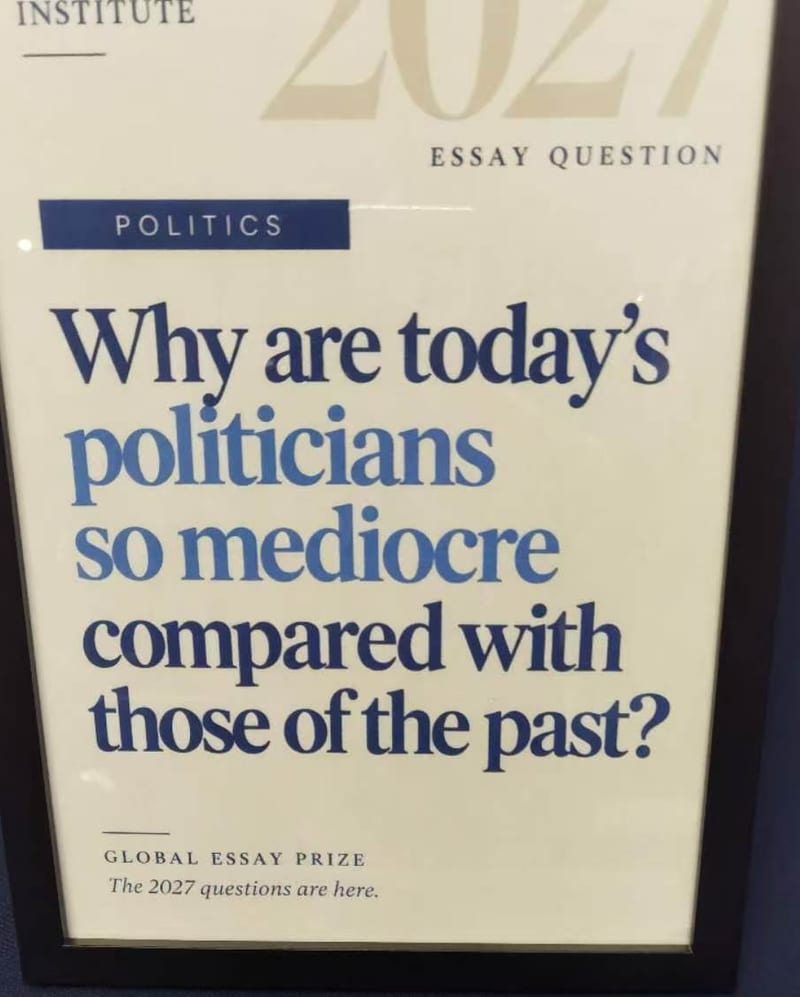
The 2027 John Locke Politics question asks: "Why are today's politicians so mediocre compared with those of the past?" It is a loaded question. It assumes a decline and asks you to explain it. So the first job is to test that assumption: define "mediocre", pick a measure and compare like with like. Below are three readings to start with and the main arguments to weigh, including the case that measured ability has not fallen at all.

The question at a glance
| Category | Politics |
| Exact wording | "Why are today's politicians so mediocre compared with those of the past?" |
| Word limit | 2,000 words for the essay body, excluding endnotes and bibliography |
| Who can enter | Any student under 19 on the submission deadline, from any country; under-15s are judged separately in the Junior category |
| Status | Shown by the John Locke Institute at its October 2026 events; the Institute's website will carry the official list |
The rules above are the 2026 rules, which we assume are unchanged. The judging criteria are "knowledge and understanding of the relevant material, the competent use of evidence, quality of argumentation, originality, structure, writing style and persuasive force." AI is allowed as a thought partner only.
What the question is really asking
Three words carry the question, and each needs a definition before you can answer.
"Mediocre" means middling, not bad. A mediocre politician is one of ordinary ability doing a job that seems to need more. So you need a measure of ability, and you need to say whether you mean the average politician or the best ones. Those are different claims. The average can rise while the outstanding figure becomes rarer, or the reverse.
"Today's" and "of the past" set up a comparison between two samples, and the samples are not alike. The present is everyone in office now, the forgettable included. The past, as most people carry it, is a short list of famous names. Nobody remembers the dull ministers of 1955. This is survivorship bias, and it is the main reason the premise feels true.
"Politicians" is broader than prime ministers and presidents. Most politicians are councillors, mayors and backbench legislators, and that is where the best evidence on quality comes from.
The live controversy is whether there is anything real behind the feeling. Economists who study political selection have measured politicians' ability directly, using test scores, education and earnings, and asked who enters politics and who gets promoted. Their findings cut against the premise on average ability. They also identify a real mechanism that can produce mediocrity: party gatekeepers who prefer followers who will not threaten them. A good essay holds both findings at once.
The trap
The trap is accepting the premise and writing a list of causes: social media, the 24-hour news cycle, low pay, career politicians, all illustrated with one country's current leaders. Every one of these may be true and the essay still fails, because it never shows that politicians have become more mediocre in the first place. The judges want a definition, a measure and evidence from more than one country. An essay that names living politicians as mediocre, with no measure behind the judgement, reads as an opinion column. Test the premise in your first third, then explain whatever survives the test.
Three core readings
1. James Bryce, "Why Great Men Are Not Chosen Presidents"
James Bryce, The American Commonwealth, vol. I, 3rd edn (London and New York: Macmillan, 1893; first published 1888), chapter VIII, from p. 78. Free scan: archive.org/details/americancommo01bryc.
Bryce, a British scholar and MP, wrote this chapter to explain to Europeans why the American presidency so rarely went to remarkable people. It is the single best piece of evidence that the complaint in this question is old. Writing in the 1880s, about a period many readers now picture as grander than our own, he says the commonplace was already the norm: "The only thing remarkable about them is that being so commonplace they should have climbed so high." He then gives mechanisms that still work, above all that parties choose candidates to win, not to govern: "when the choice lies between a brilliant man and a safe man, the safe man is preferred." Use the chapter twice: once to test the premise (if 1888 had the same complaint, "today" is not special) and once for the mechanism, which is about selection, not about the era.
2. Dal Bó, Finan, Folke, Persson and Rickne, "Who Becomes a Politician?"
Ernesto Dal Bó, Frederico Finan, Olle Folke, Torsten Persson and Johanna Rickne, "Who Becomes a Politician?", Quarterly Journal of Economics 132, no. 4 (2017): 1877-1914. Free working-paper version: NBER Working Paper 23120.
This is one of the most direct measurements of politicians' quality yet made. Using Swedish register data on every candidate for municipal and national office from 1982 to 2010, and military enlistment test scores for men born 1951 to 1980, the authors find that "politicians are on average significantly smarter and better leaders than the population they represent." Members of parliament score about 0.84 standard deviations above the average Swede on the cognitive test, and mayors match the chief executives of firms with 25 to 250 employees. Politicians also outscore their own siblings, so the selection is on ability rather than family. Use it as your main evidence that a modern democracy can, and does, select able people. Be honest about its limit: it measures one country over three decades and is not a long time series, so it shows positive selection now, not the absence of decline since 1900.
3. Besley, Folke, Persson and Rickne, "Gender Quotas and the Crisis of the Mediocre Man"
Timothy Besley, Olle Folke, Torsten Persson and Johanna Rickne, "Gender Quotas and the Crisis of the Mediocre Man: Theory and Evidence from Sweden", American Economic Review 107, no. 8 (2017): 2204-2242. Free author version: IFN PDF.
This paper explains where mediocrity comes from when it does appear. The model has party leaders choosing candidates to balance winning elections against their own survival, which competent followers threaten. That creates "a vicious circle of mediocrity where low-quality leaders select low-quality followers in order to cement their position." The test is Sweden's Social Democratic Party, which from 1993 required its local lists to alternate men and women. Across 290 municipalities and ten elections, the quota raised the competence of male politicians where it raised female representation the most, largely because mediocre male leaders resigned. Note the definition: "mediocre" here means an earnings residual below the party median, so it is a relative term. Use the paper to argue that mediocrity is produced by gatekeepers, varies from place to place within a single year, and can be broken by changing the rules of selection.
A fourth for context. Andrea Mattozzi and Antonio Merlo, "Mediocracy" (NBER Working Paper 12920, 2007), a short theoretical paper showing that "a political party may deliberately choose to recruit only mediocre politicians," even when better people want to join.
Arguments to think about
Each of these can carry a 2,000-word essay. Pick the one you can defend against its strongest objection, and make sure your essay answers that objection directly.
Reject the premise. Where ability can be measured, today's politicians do not come out worse. Swedish register data show politicians are positively selected on ability (Dal Bó and colleagues), and James Bryce made the same complaint about American presidents in 1888. What may have changed is selection: smaller parties and a professional pipeline produce politicians who are more alike, and sameness reads as mediocrity. Where real mediocrity exists, party gatekeepers can produce it, as Besley and colleagues argue for Sweden before its 1993 gender quota.
Accept the premise and blame the incentives. You can argue that the ablest people now stay out. Bryce already noted that in America "much of the best ability" went into business rather than public life, and that the scrutiny of candidates is fiercer than "the light which beats upon a throne." Pair this with the pay studies from Brazil and Italy, where higher salaries drew more educated candidates. You must then deal with Fisman's European Parliament result, which cuts the other way, and with the Swedish finding that politicians are positively selected.
The careerist thesis. A narrower claim that is easier to defend: politicians have not become less clever, but they have become less experienced in anything except politics. Use the British figures on MPs from political jobs and Runciman's account of shrinking parties. The argument is that mediocrity here means a lack of judgement formed outside Westminster or Washington, which test scores cannot see. You will need a clear definition of "judgement" and at least one comparison country.
Mediocrity is what democracy asks for. A bolder line: ordinary politicians are a feature of representative government, not a failure. Bryce observed that "the ordinary American voter does not object to mediocrity," and Dal Bó and colleagues show that Sweden selects able politicians while keeping its representatives socially representative. You could argue that a political class of brilliant outsiders would be less representative and no better at the job, and that the yearning for great leaders is itself the danger.
Whichever line you take, decide on your measure of "mediocre" before you start reading for evidence, or the essay will drift. If you would like a mentor to test that choice with you, our John Locke essay tutoring runs small groups with one-to-one sessions from January.
FAQ
Is the politicians question a good John Locke question to choose?
Yes, for a student who will read research rather than commentary. Almost everything online about it is opinion, so an essay built on measured evidence stands out at once. The risk is that it invites a rant about current leaders, which judges mark down. Choose it if you are willing to test the premise with data from at least two countries and to cite economics papers alongside a classic text such as Bryce.
What should I read for "Why are today's politicians so mediocre"?
Start with Bryce's chapter "Why Great Men Are Not Chosen Presidents" (1888), free on archive.org, to see that the complaint is old. Then read the abstract and first section of Dal Bó and colleagues' "Who Becomes a Politician?" for measured evidence, and Besley and colleagues' "Gender Quotas and the Crisis of the Mediocre Man" for the mechanism. All three have free versions. Add one data source on party membership or MPs' backgrounds.
Do I have to agree that politicians are more mediocre?
No. The question assumes it, but the judges reward essays that examine an assumption before building on it. You can reject the premise, accept it in a narrower form (for example, less outside experience), or accept it and explain it. What you cannot do is ignore it. Whichever way you go, define "mediocre" and say what evidence would show a decline.
Can I write about current political leaders by name?
You can, but sparingly and with care. An essay that calls named living politicians mediocre without a measure reads as partisan, and it will date badly before the judges read it. Use present-day leaders as illustrations of a mechanism, such as a party's selection rules or a candidate's career path, rather than as targets. Historical cases, like Bryce's presidents, let you make the same points with more distance.
Related
The John Locke Politics questions page carries this question with its trap and argument lines, alongside the 2026 Politics questions for practice. All ten 2027 questions, with the expected dates, are in our John Locke Essay Competition 2027 questions tracker. Two related 2027 questions: what the feminisation of politics is doing to policy (Public Policy) and the consequences of economic illiteracy (Economics). For the standard the judges reward, read our analysis of the published past winning essays.