The 2027 John Locke Law question asks: "Can you wrong someone without harming him?" A wrong is a breach of a duty you owe a particular person; a harm leaves that person worse off. English law gives you strong evidence that the two can come apart: trespass, battery and false imprisonment are "actionable per se regardless of whether the victim suffers any harm" (Lumba, UK Supreme Court, 2011), while in negligence damage is "the essence of the wrong". Below are three readings to start with and the main arguments to weigh.

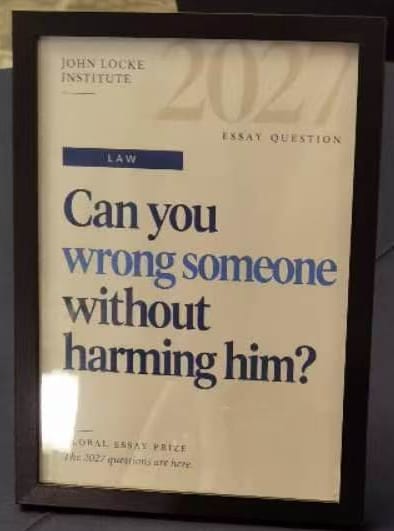
The question was shown by the John Locke Institute at its October 2026 events; the Institute's website will carry the official list.
The question at a glance
| Detail | 2027 Law question |
|---|---|
| Category | Law |
| Exact wording | "Can you wrong someone without harming him?" |
| Word limit | 2,000 words for the essay body, not counting endnotes or bibliography (2026 rules, assumed unchanged) |
| Who can enter | Any student under 19 on the submission deadline, from any country; under-15s are judged separately in the Junior category |
What the question is really asking
Two words carry the whole question, and most essays never define either.
Harm. There are two common tests. On the counterfactual test, I harm you if you end up worse off than you would have been had I not acted. On the historical test, I harm you if you end up worse off than you were before. In Harm to Others (1984), Joel Feinberg separated a plain sense of harm (a setback to someone's interests) from a normative sense (a violation of their rights), and argued that the harm that matters for criminal law is the overlap, the setbacks "that are also wrongs". That move already concedes the point at issue: if every wrong were a setback, there would be no overlap to look for.
Wrong. To wrong someone is not just to act wrongly. It is to breach a duty owed to that person, so that he, and not just anyone, has standing to complain. Wasting your own talents may be wrong, but it wrongs no one in particular. Breaking your promise to me wrongs me.
The question, then, is whether the second can happen without the first. The hidden assumption worth exposing is that harm is the only thing that gives a person a complaint. Mill's harm principle rests on something close to it: power may be exercised over anyone against his will only "to prevent harm to others". If there are wrongs without harms, either the harm principle is incomplete or those wrongs are beyond the law's reach.
The live controversy runs in both philosophy and law. Philosophers argue over whether harm can be defined broadly enough to cover every wrong. Judges argued over it in 2011, when the UK Supreme Court split on whether a man who would have been detained anyway can complain of being detained unlawfully.
The trap
The trap is answering "yes, trespass" in one line and then writing 1,900 words of moral philosophy. A strong student knows the trespass example and treats it as a starting intuition, not as evidence. This is a Law question, and the judges in this category reward doctrine used to make a point. The interesting part is how the law handles harmless wrongs once it admits them: who must prove what, which wrongs need damage and which do not, and what a court awards when the claimant has lost nothing. Those details are the evidence for your answer. An essay that cites Entick v Carrington as an illustration and moves on has missed them.
Three core readings
1. R (Lumba) v Secretary of State for the Home Department [2011] UKSC 12
Full judgment: caselaw.nationalarchives.gov.uk/uksc/2011/12
The Home Secretary detained foreign national prisoners under an unpublished policy that was inconsistent with her published one. A majority of six held this was false imprisonment. Yet Lord Dyson found that, had the published policy been applied, "it is inevitable that the appellants would have been detained", so they "suffered no loss or damage" and got nominal damages. That is a wrong without harm, found as a fact by the highest court. Read paras 62 to 101 (Lord Dyson), Lady Hale at paras 196 to 218, and Lord Brown's dissent from para 340. Lady Hale and Lord Brown disagree about exactly the question you are answering. The sentence to quote: "Trespassory torts (such as false imprisonment) are actionable per se regardless of whether the victim suffers any harm" (para 64).
2. Entick v Carrington (1765) 19 St Tr 1029
Text of the State Trials report: constitution.org/trials/entick/entick_v_carrington.htm
John Entick sued the King's messengers who broke into his house in November 1762, searched it for four hours and seized his papers. Lord Camden's judgment is famous for the rule of law, but the passage you need is about trespass: "By the laws of England, every invasion of private property, be it ever so minute, is a trespass. No man can set his foot upon my ground without my license, but he is liable to an action, though the damage be nothing." Use it for two points. The wrong is complete without damage, and the burden is on the intruder to show "that some positive law has empowered or excused him". One caution for a careful essay: in 2022 Christian Burset and T. T. Arvind published a newly found manuscript report of the case (110 Kentucky Law Journal 265) arguing that the version courts rely on is flawed. Cite the State Trials text, and note in an endnote that its wording has been questioned.
3. John Stuart Mill, On Liberty, chapter 1
Free text: gutenberg.org/files/34901/34901-h/34901-h.htm
Mill is the opponent your essay needs. His principle is "that the sole end for which mankind are warranted, individually or collectively, in interfering with the liberty of action of any of their number, is self-protection", and "the only purpose for which power can be rightfully exercised over any member of a civilised community, against his will, is to prevent harm to others." If you argue that harmless wrongs exist and that the law rightly forbids them, you must say what this does to Mill: either his "harm" is wider than it looks, or the law of trespass breaks his rule. Read chapter 1 only; it is short.
A fourth, if you can get it. Arthur Ripstein, "Beyond the Harm Principle" (2006) 34(3) Philosophy & Public Affairs 215 to 245 is the best modern article on this question. It is paywalled, but its central example (a stranger who naps in your bed and leaves no trace) and its alternative to Mill are reproduced in Alessandro Spena's open-access "Harmless Rapes? A False Problem for the Harm Principle", Diritto e Questioni Pubbliche 10/2010, which is also a clear guide to the Feinberg and Gardner debate.
Arguments to think about
Each of these can carry a 2,000-word essay. Pick the one you can defend against its strongest objection, and make sure your essay answers that objection directly.
Yes, for rights of control. Trespass, battery and false imprisonment are actionable without proof of loss, and Entick v Carrington awarded damages for a search "though the damage be nothing". Negligence is the exception, because there damage is the essence of the wrong. On this view the line the law draws tracks the difference between your authority (over your land, your body, your liberty) and your welfare. The objections to meet come from inside the law, in the divided judgments in Lumba, and from philosophy: perhaps nominal damages show the law treating these wrongs as harms after all.
No: every wrong is a harm, properly understood. Take Feinberg's normative sense of harm seriously and argue that the plain sense was never the right one. Spena argues along these lines that, once harm is understood correctly, even the case Gardner and Shute call harmless rape cannot be harmless. The task is to define harm broadly enough to cover the napping stranger and the Lumba detainees without making it mean "wrong", and to explain why compensatory damages track only the narrow sense.
Yes, but the law should only act on the harm. Concede that harmless wrongs exist and defend Mill anyway. John Gardner and Stephen Shute argued that the harm principle is met if failing to prohibit an action would be harmful, even when the action itself is not: "It is enough to meet the demands of the harm principle that, if the action were not criminalized, that would be harmful" (quoted in Spena). A rule against harmless trespass prevents the many harmful ones. This essay would explain trespass as a rule justified by aggregate harm, and would have to deal with Murray's unaware detainee.
Yes, and beyond rights of control. Parfit's non-identity problem gives harmless wrongs where no one's land, body or liberty is touched. A choice that brings a particular child into existence with a hard life cannot make that child worse off, because without it he would not exist; yet many think the child is wronged. The Stanford Encyclopedia entry by M. A. Roberts sets out the rights-based answer and notes that "wrongful life" claims are brought "on behalf of the child rather than the parent". This line asks why the law is so reluctant here when it is so ready in trespass.
Whichever line you take, a Law essay is judged on how well it uses cases, so read the judgments, not summaries of them. Our John Locke essay mentors work through the key cases with students before the first draft.
FAQ
Is "Can you wrong someone without harming him?" a good John Locke Law question to choose?
Yes, if you are willing to read cases. It is one of the few Law questions with a clear, defensible answer backed by settled doctrine, which leaves room for originality in explaining why the law draws the line where it does. It suits students who like precise definitions. It is a poor choice if you plan to write pure moral philosophy, because the Law judges will expect authorities.
What should I read for the John Locke "wrong without harm" question?
Start with Lord Dyson's judgment in R (Lumba) v Home Secretary [2011] UKSC 12, paras 62 to 101, then Lady Hale and Lord Brown. Add Lord Camden's passage on trespass in Entick v Carrington and chapter 1 of Mill's On Liberty. For the philosophy, Ripstein's "Beyond the Harm Principle" is the key article; Spena's open-access paper reproduces its main example and maps the Feinberg and Gardner debate.
What is the difference between wronging someone and harming them?
Harming someone makes him worse off, judged either against how he was before or how he would otherwise have been. Wronging someone breaches a duty owed to him in particular, which gives him a complaint. The two usually travel together, which is why they are easy to confuse. Trespass to land, battery and false imprisonment are the standard legal examples of wrongs that need no harm; negligence is the standard example of a wrong that does.
Do I need to cite cases in this John Locke Law essay?
You should. The question is philosophical in form, but it is set in the Law category, and the most persuasive evidence for either answer is what courts do when a claimant has been wronged and has lost nothing. Use a recognised citation form such as OSCOLA in your endnotes, cite paragraph numbers for modern judgments, and quote only what you have read in the judgment itself.
Related
The John Locke Law questions page carries this question with its trap and argument lines, alongside the 2026 Law questions for practice. All ten 2027 questions, with the expected dates, are in our John Locke Essay Competition 2027 questions tracker. Two related 2027 questions: is there anything wrong with posing or looking (Philosophy) and what the feminisation of politics is doing to policy (Public Policy). For the standard the judges reward, read our analysis of the published past winning essays.